
Easy Scoring with ASIS
Administer the test and enter the raw scores on the practitioner page at projeiq.com; the system will automatically provide standard scores, reports and interpretations.


With the support of Anadolu University and the Ministry of National Education, our ÜYEP Center research team developed Türkiye's first native intelligence scale: the Anadolu Sak Intelligence Scale.


Download ASIS's technical validity and reliability report download.
Download ASIS's discriminant validity report for special education groups download.
Download the article on ASIS's validity in identifying gifted children download.
Download the article on ASIS's social validity download.

Project IQ is the research group led by Prof. Dr. Uğur Sak that developed the ASIS intelligence scale and conducts scientific research on intelligence. With the support of Anadolu University and the Ministry of National Education, we, the research team of the ÜYEP Center, developed the Anadolu Sak Intelligence Scale, Türkiye's first native intelligence scale. For the ASIS technical reports, see the links below; for scientific articles, see the articles on the scientific research page. In recent years ASIS has been the intelligence test on which the most scientific research has been conducted in Türkiye. 32 scientific articles or graduate theses have been published on ASIS.
The pilot stage of the project was completed with 1201 children aged 4-12, the standardisation stage with 4641 children, and the validity and reliability studies with more than 800 children, including special education groups. In addition to these studies, ASIS has been used as the criterion intelligence test in research on topics such as humour and creativity. Among the individual intelligence tests in the world, ASIS has the highest representativeness in terms of sample size per age group. Its validity and reliability values were found to be very good to excellent.
The first intelligence scale studies in Türkiye began in 1915 with the adaptation of the Stanford-Binet Intelligence Scale, and a culture of adapting intelligence scales formed over the following 100 years. With Project IQ we aimed both to give our country a native intelligence scale and to lead the development of new intelligence scales by breaking this culture of adaptation. In 1916 Lewis M. Terman, a professor at Stanford University, revised Alfred Binet's prototype intelligence scale, regarded as the first intelligence scale, and after carrying out standardisation and norm studies published it as the Stanford-Binet Intelligence Scale. Stanford in the name is Stanford University, where Terman worked, and Binet is Alfred Binet's surname. Pointing to this historical fact, we combined the names of Anadolu University, which funded the project, and Prof. Dr. Uğur Sak, who developed the prototype of the scale, and named it the Anadolu-Sak Intelligence Scale (ASIS for short; in Turkish, Anadolu-Sak Zeka Ölçeği).
ASIS is an individually administered intelligence scale that objectively measures general intelligence and the main components that make up general intelligence. Consisting of seven subtests, ASIS provides eleven different component profiles in addition to subtest skill performances.

32 publications: 18 articles, 14 theses, 2016–2024
2024 Article
2024 Article
Bal-Sezerel, B., Arslan, D., & Sak, U. Measurement: Interdisciplinary Research and Perspectives
2023 Article
Arslan, D., & Sak, U. Journal of Psychoeducational Assessment, 41(5), 542-555
2023 Article
Öpengin, E., & Bal Sezerel, B. Journal of Pedagogical Research, 7,4, 400-413
2023 Article
Avcı-Dogan, G., Akbulut, Y., & Sak, U. Infant and Child Development, 32 (4), e2427
Stay informed about announcements and updates on ASIS.
Administer the test and enter the raw scores on the practitioner page at projeiq.com; the system will automatically provide standard scores, reports and interpretations.
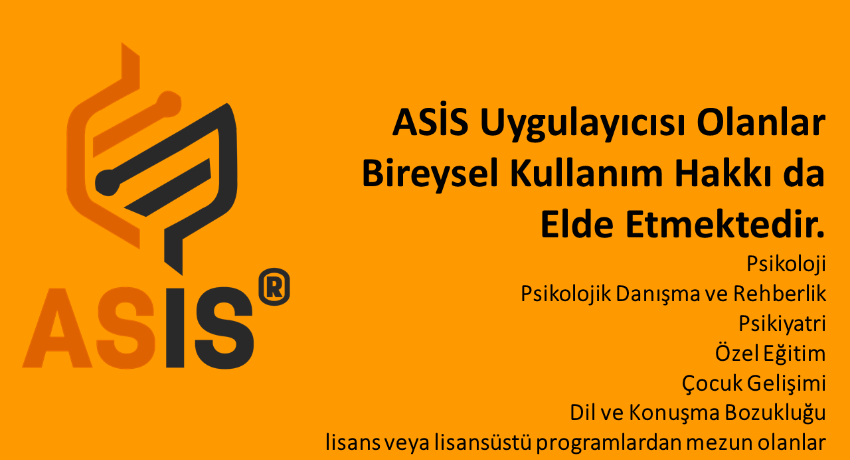
People who complete ASIS practitioner training will also hold the right to use ASIS, together with all legal rights.

We have agreed with the Ev Okulu Association on organising ASIS training in Istanbul and the Thrace region.